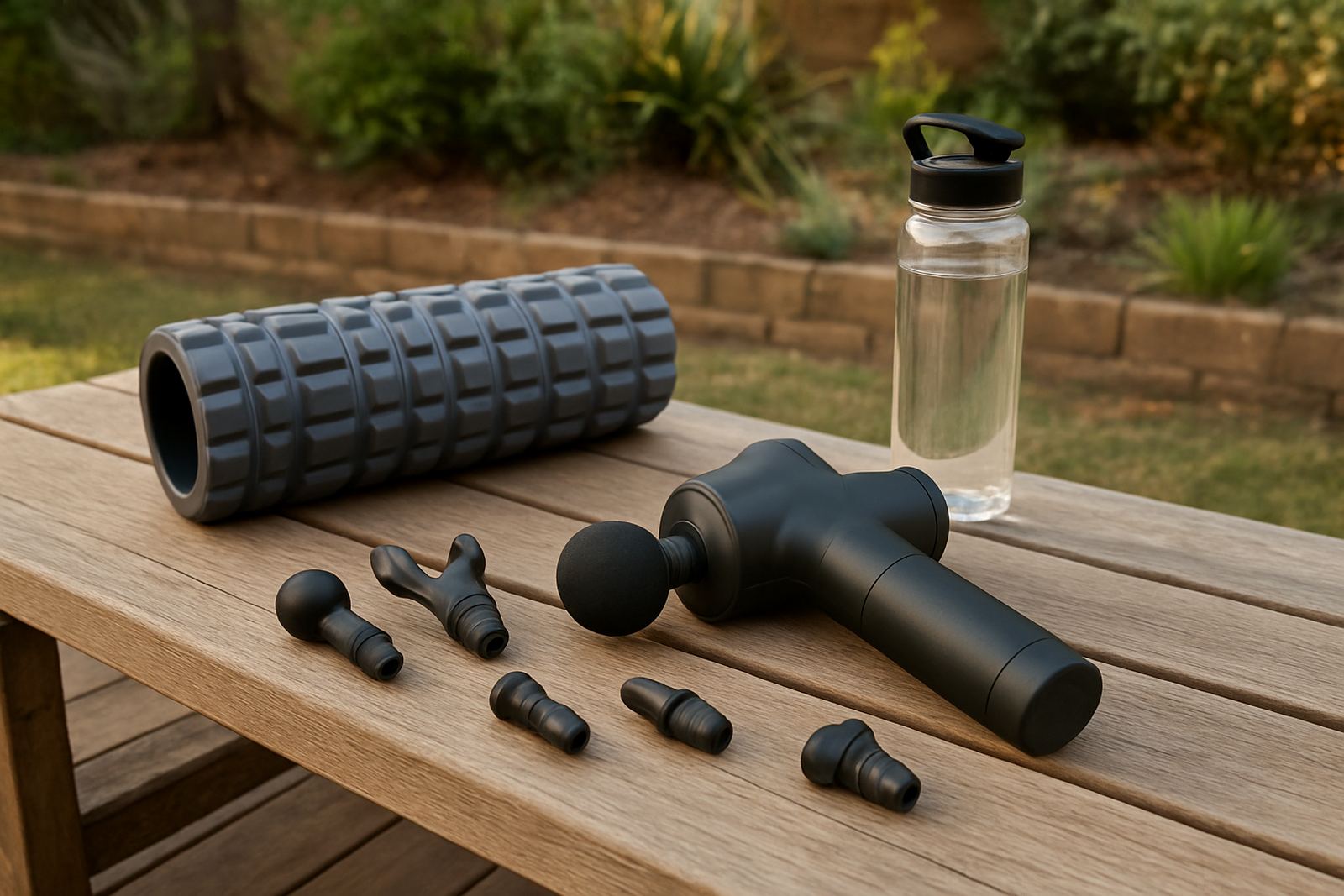
What a Massage Gun Does After Training
A massage gun uses rapid percussion to work into sore or tight muscle groups after exercise. It is not a medical device, but it can help with recovery routines, warm-up prep, and day to day muscle comfort. For people training at home in Fourways, Sandton, Midrand or anywhere else in South Africa, it gives a practical way to manage post-session stiffness without booking a treatment every time.
Most users keep it for legs, glutes, back, shoulders and calves. It is useful after running, cycling, strength work, hiking, or a heavy gym day. The key is controlled use for short periods, not pushing hard for long stretches. Used properly, it can help keep a routine going when your body feels a bit flat.
Motor Speed, Attachments and Size Options
Massage guns come in different sizes and output levels, so it helps to match the unit to your training load and how often you plan to use it. Lighter models suit casual home use and travel, while larger units are better for regular recovery work and deeper muscle groups. Some sets include several heads for different areas, which makes them more useful across the body.
- Compact unit for storage in a training bag or small apartment
- Mid-size model for regular home recovery sessions
- Higher-torque model for stronger percussion and longer sessions
- Rounded head for large muscle groups like quads and glutes
- Flat head for general use across the back and thighs
- Fork head for the sides of the spine and the Achilles area
If you train in a shared home, a lighter and quieter model is usually easier to live with. If you are looking after a family and only get 10 or 15 minutes between commitments, a simple setup with one or two speed levels can be enough. More settings are not always better, especially if the unit feels heavy in the hand.
Where It Suits Best in the Home
This product suits home gyms, spare rooms, garage setups and apartment spaces where training happens before or after work. It also works well in a study nook or living room corner next to other training tools. In Johannesburg and Pretoria East, many buyers want something that can handle regular use but still pack away quickly after the session.
Massage guns are best where you have a chair, yoga mat or bench nearby. You do not need special mounting, plumbing or gas supply. Charging is usually the main practical point. With load-shedding in mind, it helps to keep the unit topped up after use and to store the charger in the same place each time so it is easy to find.
- No installation required
- Works from rechargeable battery power
- Best used on a dry indoor surface
- Keep away from moisture and direct sun
- Allow space to change attachments safely
Charging, Battery Life and Daily Use
Most massage guns use a rechargeable lithium battery and charge from a standard wall socket. Battery life depends on speed setting and how hard the unit is working. A lower setting usually lasts longer, while stronger settings shorten run time. For many home users, that is fine because a recovery session often only takes a few minutes per muscle group.
Check the charging cable type, plug point needs and charging time before you order. If you share the home with other trainers, it helps to know whether the battery is removable or built in. A simple unit can be easier to manage during power cuts, since you can charge it when the supply is back and then use it during the next session. On a practical level, that is often enough.
Keep the percussion head moving and do not press too hard. Let the device do the work. If the muscle feels bruised or the skin is irritated, stop and give it a break. A massage gun is a recovery aid, not a fix for every pain.
Care, Cleaning and Servicing
Care is straightforward. Wipe the body of the unit with a dry or slightly damp cloth after use, then keep the heads clean and dry. Sweat and dust build up over time, especially if the device lives in a garage gym or near open windows in coastal humidity. Store it in a cool, dry place and avoid leaving it in a hot car boot for long periods.
Check the attachment sockets, battery contacts and power cable regularly for wear. If the motor starts sounding uneven, the battery drains very fast, or the unit vibrates more than usual in the hand, it may need attention. We also suggest checking the carrying case, because cracked cases lead to damaged heads and loose fittings.
- Wipe after each session
- Do not immerse in water
- Keep heads in the case or pouch
- Charge before the battery runs flat for long periods
- Inspect for loose parts every few weeks
What to Check Before You Order
Before ordering, check the spec sheet carefully so you get a unit that matches your training habits. The right choice depends on handle weight, amplitude, battery life, speed range and the number of heads included. If you are buying for family use, make sure the controls are simple enough for everyone to manage safely. If it is for one athlete, deeper percussion and a stronger grip may be more important than extra extras.
It is also worth checking delivery coverage, warranty terms and support for first-time setup. Our team in Fourways can help customers across Sandton, Midrand, Randburg, Roodepoort and Pretoria East, with nationwide delivery available for homes outside Gauteng. If you are unsure which version suits your recovery routine, ask for help before checkout so you do not end up with a unit that feels too light or too heavy in the hand.
- Battery run time and charging time
- Number of speed levels
- Amplitude or stroke depth
- Weight and grip comfort
- Included massage heads
- Warranty and support details
Key facts
| Product type | Handheld percussion massage gun |
|---|---|
| Power | Rechargeable battery, charging via wall socket |
| Speed settings | Multiple intensity levels, depending on model |
| Attachments | Typically 4 to 6 massage heads |
| Use | Home recovery, warm-up and post-training muscle care |
| Support area | Fourways, Johannesburg with nationwide delivery |