
Start with the movement, not the full pull-up
A clean pull-up starts before your chin reaches the bar. The first goal is to learn how your shoulders, core and grip work together when you hang, brace and pull. If you jump straight to repeated attempts at a full rep, it is easy to shrug through the neck or swing the body and lose control.
Begin with dead hangs for 10 to 20 seconds, then build to controlled active hangs where the shoulders stay packed down. From there, use small holds at the top position, assisted pulls, and slow negatives. That sequence gives the body time to adapt and helps you see where the weak point is, whether that is grip, mid-back strength or core control.
- Dead hang: 3 sets of 10 to 20 seconds
- Active hang: 3 sets of 5 to 10 seconds
- Top hold: 3 sets of 3 to 5 seconds
- Slow negative: 3 to 5 reps with a 3 to 5 second lower
Use assistance well before chasing your first full rep
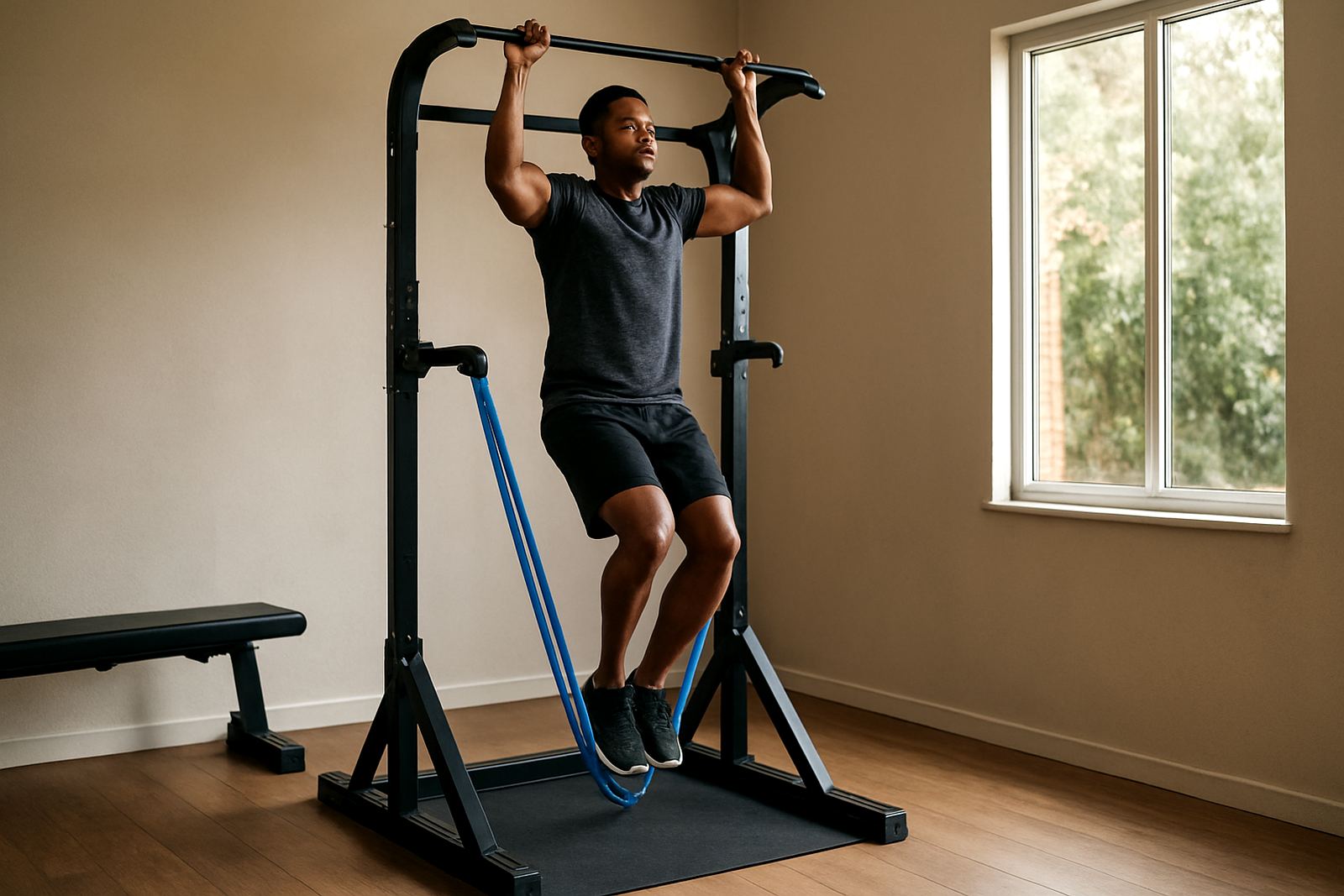
Assistance is not cheating. It is a practical way to keep the movement honest while you build strength. A resistance band, a chair under one foot, or a lower bar setup can reduce load enough for you to practice the full pulling pattern with better form. The key is to use just enough help to stay controlled, not so much that the exercise becomes a bounce.
For many people, the best progression is to start with 5 to 8 assisted reps, then reduce the help over a few weeks. If the last two reps are tidy and the shoulders stay level, you are on the right path. If the chin cranes forward or the lower back arches hard, the set is too heavy for now.
- Choose assistance that lets you keep a smooth tempo
- Stop a set when form starts to break
- Reduce help in small steps, not big jumps
- Train 2 to 3 times a week, with rest days in between
Build the muscles that make pulling easier
Pull-ups are a compound movement, so they need more than one muscle group working well together. The lats do a lot of the heavy lifting, but the upper back, biceps, forearms and even the trunk have to hold their share. If one part is lagging, the full movement feels much harder than it should.
Support work is useful when done consistently. Rows, scapular pulls, biceps curls, face pulls and hollow body holds all help. You do not need a huge list of exercises. Pick a few and repeat them often enough to make them better.
- One horizontal pull, such as a row
- One vertical pull, such as a banded pull-down
- One arm accessory, such as curls or hammer curls
- One core drill, such as a hollow hold or plank
In home gyms across Johannesburg, people often improve faster when they keep support work short and tidy. Ten focused minutes after the main session can do more than a long random workout.
Protect the shoulders and elbows while you progress
Pulling volume can creep up quickly, especially when you start feeling stronger. That is where many home trainers get sore. The shoulder joint likes control, and the elbow tendons prefer steady loading rather than sudden bursts of effort. If you train through pain, your progress can stall for weeks.
Warm up before every session with arm circles, band pull-aparts and light rows. Keep your ribs down and avoid yanking from a dead stop. A little pause at the bottom of each rep can help reduce swinging and give your joints a cleaner line of force.
- Warm up for 5 to 8 minutes before pulling
- Keep elbows slightly in front of the body on the way down
- Do not force range if the shoulders feel pinchy
- Use a rest day if tendon soreness builds up
If you are training in a flat in Sandton or a townhouse in Midrand, space matters too. Make sure the bar or station is set up with enough ceiling clearance and stable footing. On rainy days or during load-shedding, a rushed setup often causes more trouble than the workout itself.
A simple weekly pull-up progression you can actually follow
A good plan should fit into normal life. You do not need to train pull-ups every day to improve. Two focused sessions and one lighter support day are enough for most beginners and early intermediates. The trick is to keep the work repeatable.
Here is a practical weekly structure:
- Day 1: Assisted pull-ups, top holds, rows
- Day 2: Dead hangs, negatives, core work
- Day 3: Lighter support work, mobility and grip
For each session, aim for quality reps before volume. If you can do 4 clean assisted reps for 4 sets, stay there until those sets feel steady. Then reduce assistance slightly. That small change is what moves you forward without forcing a bad rep.
A Fourways example that shows how small changes add up
Consider someone training at home in Fourways who wants to get their first strict pull-up before winter. They work long office hours, get home in traffic, and only have 25 minutes after supper. Their first mistake is trying max-effort attempts every session. Their shoulders are tired, the grip gives out early, and motivation drops.
Once they switch to a clearer progression, things change. On Monday they do assisted reps with a band, on Wednesday they hold the top position and lower slowly, and on Saturday they add rows and hangs. After a few weeks, the movement feels less frantic. They are not just trying harder, they are training better. That difference matters when time is tight and the whole family wants access to the space.
For households balancing school runs, work and home training, keeping the session short and predictable often works best. A pull-up plan that fits around real life is more likely to stick than one that only works on paper.
When to move from practice to full reps
You are ready to test full pull-ups when your assisted sets look controlled, your negatives stay slow, and your shoulder position stays stable from start to finish. A useful milestone is being able to do 3 sets of 5 strict negatives with no swing and then 3 sets of 6 to 8 assisted reps with good form.
Test full reps sparingly. One or two attempts at the start of a session is enough. If you get a clean rep, stop there and finish the workout with assistance and support work. That keeps the nervous system fresh and limits sloppy attempts. The goal is not to force a number, it is to build repeatable strength that you can trust.
Over time, that steady approach helps whether you are training for general fitness, body composition or sport. Better pull-up practice is really about better control, better patience and better use of each training minute.